This is a detailed explanation of the structure and working principle of an automatic rotating table.
An automatic rotating table, also known as an electric turntable or automatic turntable, functions by rotating at a set speed and direction under the drive of a motor, providing convenience for scenarios such as presentations, dining, and production.
I. Basic Structure
A typical automatic rotating table mainly consists of the following parts:
1. Tabletop
· Material: Glass, solid wood, engineered wood, stone, etc. It is usually designed with two layers: the upper layer is a decorative tabletop, and the lower layer is the load-bearing and mounting structure.
· Shape: Circular is the most common (for uniform torque), but square or custom shapes are also available.
2. Rotation Mechanism (Core Component)
· Drive Motor: Usually a low-speed, high-torque synchronous motor or stepper motor. They provide smooth, quiet rotational force and stable speed, not easily affected by load changes.
· Reduction Gear Set: The motor speed is usually still higher than the slow speed required by the tabletop (e.g., 1-4 revolutions per minute). The reduction gear set converts the high-speed, low-torque output of the motor into low-speed, high-torque operation suitable for the desktop, ensuring smooth rotation even under heavy loads.
• Transmission Device:
• Gear Drive: The motor gears drive a large-diameter internal or external gear ring, achieving smooth, precise transmission with high load-bearing capacity.
• Friction Wheel Drive: The motor directly drives the turntable under the desktop via rubber or polyurethane friction wheels. Simple structure, low noise, but relatively low torque capacity.
• Rotary Bearing: Typically uses a large slewing bearing or a set of composite roller/ball bearings. Located between the desktop and the base, it bears the entire weight of the desktop and overturning moment, ensuring smooth rotation, low friction, and low noise.
3. Control System
• Control Circuit Board (MCU Mainboard): The brain of the entire system, receiving commands and controlling the motor.
• Power Supply: Converts AC mains power (220V/110V) to low-voltage DC power (such as 12V or 24V) suitable for the motor and control circuit.
• Control Interface:
• Wired Remote Control: The most common type, integrating a power switch, speed adjustment (multi-speed or stepless), and forward/reverse switch.
• Wireless Remote Control: Controlled via infrared or radio frequency, offering greater convenience.
• Touch Control: More advanced desktops may integrate a touchscreen or capacitive touch buttons.
• Sensors (Optional): Some high-end models are equipped with infrared or gravity sensors to achieve intelligent functions such as “rotates when someone approaches, stops when someone leaves” or automatic pause/reverse to prevent collisions.
4. Base and Stand
• Fixed Part: Supports the entire rotating mechanism and desktop, and houses the motor and control system. It usually has cable routing holes for easy power cord routing from the legs.
5. Auxiliary Components
• Slip Ring (for applications requiring external power): A slip ring is installed if the desktop needs to connect to electrical equipment such as lights, induction cookers, or microphones. It consists of a slip ring in the rotating part and brushes in the fixed part, transmitting power and signals while rotating continuously, preventing wire tangling. • Limit switch/return device (optional): Ensures desktop rotation remains within a certain range, or allows setting a “zero” position.
—
II. Working Principle
Its working principle can be summarized as a closed-loop process of “control command -> motor drive -> deceleration and torque increase -> smooth rotation”.
1. Start-up and Command Input:
• The user presses the start button via remote control and selects the speed and direction (forward/reverse).
• The control circuit board receives the command signal.
2. Motor Drive and Speed Regulation:
• The control circuit, based on the speed command, outputs power of corresponding magnitude and frequency to the drive motor through pulse width modulation (PWM) technology or voltage regulation.
• PWM speed regulation: By using a fast switching circuit, the duty cycle of the motor’s energization time is changed. A higher duty cycle results in a higher average voltage and a faster motor speed; conversely, a lower duty cycle results in a slower speed. This is the most commonly used and energy-efficient speed regulation method.
3. Power Transmission and Reduction:
• The motor shaft begins to rotate, its speed significantly reduced by an internal or external reduction gear set, while the output torque increases exponentially.
• The high-torque power, after reduction, is transmitted through a small gear on the output shaft to a large gear ring rigidly connected to the desktop (or via friction transmission through a friction wheel).
4. Desktop Rotation:
• The large gear ring drives the entire desktop assembly, rotating smoothly and at a constant speed along the track of the slewing bearing.
• The bearing bears the vertical pressure and horizontal torque, making the rotation extremely smooth.
5. Control and Protection:
• Throughout the process, the control system continuously monitors the current and operating status. If abnormal resistance is encountered (such as jamming), the current will rise abnormally, triggering overload protection on the circuit board and automatically cutting off power to prevent the motor from burning out.
• When using wireless remote control or smart sensors, the system will respond in real time to new commands such as “pause” and “reverse”.
—
III. Key Technologies and Features
* **Smooth Operation and Quiet Operation:** Thanks to low-speed synchronous motors, precision gear/friction transmission, and high-quality bearings, modern automatic rotating tables operate very smoothly and quietly.
* **High Load Capacity:** This depends on the bearing specifications and motor torque. Commercially available large turntables can support hundreds of kilograms.
* **Safety and Reliability:** Utilizes low-voltage DC motors, ensuring safety and preventing electrical leakage. Features multiple protections against overheating, overcurrent, and overload.
* **Intelligent Trend:** Integrates with the Internet of Things (IoT), allowing control via a mobile app, preset rotation modes, and even integration with restaurant queuing systems.
IV. Main Application Scenarios
* **Catering Industry:** Banquet tables, buffet tables, conveyor belt sushi counters.
* **Display and Retail:** Product display stands, jewelry and watch display cases, museum display stands.
* **Industry and Inspection:** Rotary tables used as part of automated production lines or for precision inspection.
* **Home and Entertainment:** Rotary tabletops for large family gatherings.
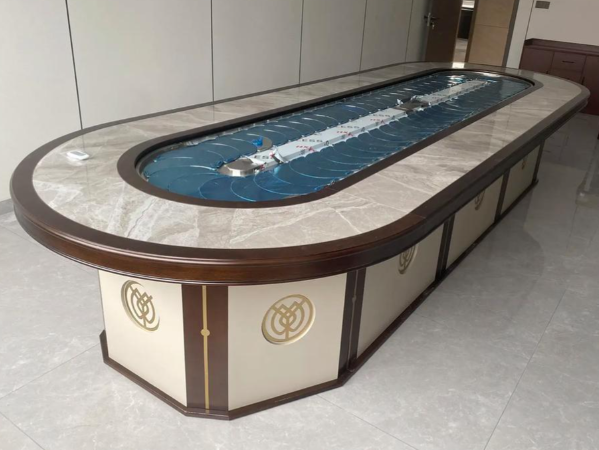
In summary, the automatic rotating table is a small, precision mechatronics product that integrates mechanical design (transmission and bearings), motor technology, and electronic control. Its construction revolves around the core objective of “smoothly driving heavy-load rotation,” achieving convenient and elegant rotation through precise component matching and intelligent control.
Post time: Dec-04-2025