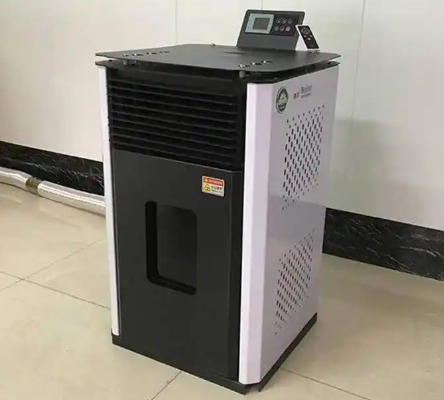
Okay, let’s delve into the structure and working principle of a pellet fireplace (i.e., a pellet stove). This will be more specific than just the working principle, focusing on its internal structure and the synergistic effect of its various components.
You can think of it as a sophisticated “automatic combustion system” that perfectly combines mechanical automation, combustion science, and electronic control technology.
I. Core Structure
A pellet fireplace mainly consists of the following eight core components:
1. Hopper
· Function: A compartment for storing biomass pellet fuel.
· Features: Usually located at the top of the stove body; its capacity determines the continuous operating time after a single feed (ranging from tens of hours).
2. Screw Feeder
· Function: This is the key to “automation.” It is a motor-driven screw that, like a syringe, precisely and quantitatively pushes the pellets from the bottom of the hopper into the combustion chamber.
· Control: The feeding speed is precisely adjusted by a control panel, directly determining the fire size and heat output.
3. Combustion Chamber
* Function: The place where the fuel undergoes combustion.
* Features: Usually made of special high-temperature resistant and corrosion-resistant cast iron or ceramic materials, capable of withstanding prolonged high-temperature burning. Its bottom has a component called a “combustion bowl” or “grate,” allowing air circulation and ash to fall.
4. Ignition Unit
* Function: Automatically ignites the pellets. It is usually an electric heating wire that is heated to a red-hot state (approximately 800°C or higher) upon startup, directly igniting the first batch of pellets falling from the feeder.
5. Fan System
Pellet furnaces are typically equipped with three independent fans, each with its own function:
* Combustion Fan: Draws in air from outside or inside and forces it into the combustion chamber, providing the necessary oxygen for combustion. This ensures efficient and complete combustion.
* Convection Fan: Also known as a room fan. It draws in cool indoor air, forces it to flow over the heated surface of the heat exchanger, absorbs heat, and then blows the hot air back into the room for heating. • Exhaust Fan: Located behind the combustion chamber, it generates negative pressure, forcibly expelling combustion exhaust gases outdoors through the exhaust pipe. Its power needs to be matched with the combustion fan to ensure that smoke and dust do not escape into the chamber.
6. Heat Exchanger
• Function: A device for efficiently recovering heat.
• Structure: Typically a metal pipe or fin array surrounding the combustion chamber. The heat from the flame and high-temperature flue gas is absorbed by the metal, while the indoor air flowing over its outer surface (driven by a convection fan) is heated.
7. Control System (Brain)
• Core: A main control circuit board.
• Input: Receives user commands from the control panel/remote control (such as setting temperature, fire level), and real-time feedback from temperature sensors.
• Output: Precisely controls the speed of the feed motor, the rotation speed of each fan, and the on/off state of the igniter based on commands and feedback.
8. Ash Collection Box
• Function: Collects a small amount of ash produced after combustion. Regular cleaning is required (usually every 1-3 days, depending on usage frequency and particle quality). —
II. Detailed Working Principle and Flowchart
Let’s connect these components in series and see how they work together:
Step 1: Start-up and Ignition
1. The user sets the temperature or fire level via the panel or remote control.
2. The control system is powered on, and the igniter begins heating.
3. The screw feeder rotates for a few seconds, feeding a small amount of particles into the combustion chamber.
4. The combustion fan and exhaust fan begin operating at low speed, providing initial air.
Step 2: Combustion and Heat Generation
1. The heated igniter ignites the particles, establishing a flame.
2. The control system detects the flame (usually through a photoelectric sensor or temperature sensor) and shuts off the igniter.
3. Entering stable operating state:
· The feeder continues to deliver particles at the set speed.
· The combustion fan provides optimal combustion air according to the settings, ensuring complete combustion.
· The flame continues to burn in the combustion chamber, and the enormous heat is absorbed by the combustion chamber walls and heat exchanger.
Step 3: Heat Exchange and Distribution
1. The convection fan operates at full capacity, drawing cool indoor air into the furnace.
2. The cool air flows over the high-temperature heat exchanger surface and is rapidly heated.
3. The heated air is blown out of the vent by the fan, circulating throughout the room and raising the room temperature.
Step 4: Exhaust and Intelligent Adjustment
1. The exhaust fan continuously discharges combustion exhaust gases outdoors through the exhaust pipe.
2. Temperature sensors monitor the indoor temperature or the internal temperature of the furnace in real time and feed the data back to the control board.
3. Based on the feedback, the control board dynamically fine-tunes the feeding speed and fan speed:
· When approaching the set temperature, the feeding rate is reduced, switching to low flame or standby mode.
· When the temperature drops, the feeding rate is increased to enhance the firepower.
Step 5: Shutdown and Cooling
1. The user issues a shutdown command.
2. The feeder immediately stops feeding, cutting off the fuel supply.
3. The igniter stops working.
4. The combustion fan, exhaust fan, and convection fan will continue to run for a period of time (10-30 minutes), which is a crucial “cooling cycle”:
· Burns away any remaining pellets in the combustion chamber.
· Cools the combustion chamber and heat exchanger, preventing residual heat from damaging components.
· Completely exhausts any remaining exhaust gases outdoors.
5. After the cooling cycle is complete, the system shuts down completely.
Core Principle Summary
The essence of a pellet stove is a “controlled fuel-air precision ratio system.” Through precise electronic program control of the fuel (pellets) and air (oxygen) supply, near-perfect combustion efficiency (typically exceeding 85%) is achieved. Simultaneously, forced heat exchange and intelligent temperature control maximize heat delivery into the room, avoiding the significant heat loss through the chimney that occurs in traditional fireplaces.
This sophisticated construction and principle make pellet stoves far superior to traditional wood-burning equipment in terms of convenience, environmental friendliness, and energy efficiency.
Post time: Nov-20-2025