With the rapid development of society, speed reducers are being used more and more widely. They play a very important role in production, processing, logistics and other fields, and usually play an important role in transmission and speed reduction.
Among them, the RV reducer is a relatively new type of transmission. It is developed from the traditional pinwheel planetary transmission and not only overcomes the shortcomings of the general pinwheel transmission, but also has a series of advantages such as small size, light weight, high efficiency, and smooth transmission. However, many people are still not very familiar with the structure of the RV reducer. A better understanding of the equipment will lead to better application. Let me give you a brief introduction below.
Most RV reducers are predominantly blue or silver in appearance, with aluminum alloy as the outer shell. Larger models, such as RV110 and above, use cast iron shells, similar to aluminum-cased motors. Smaller models mostly use aluminum shells because they are lightweight, while larger models often use high-rigidity cast iron because of its high strength.
The RV series reducer is mainly composed of a housing, worm gear, worm wheel, bearings, seals and other small parts. Due to its worm gear and worm wheel structure, this reducer has relatively low noise, can output high torque, and is suitable for various working conditions.
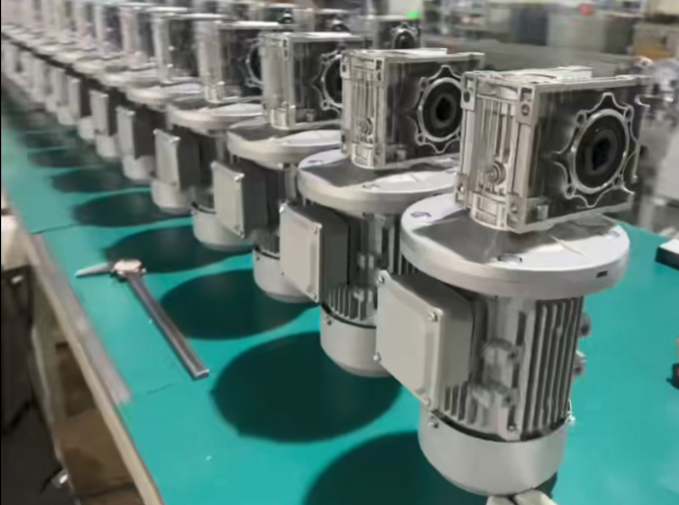
Referring to the image above, the working principle of this RV reducer involves connecting the motor to the flange and transmitting power to the worm gear via a worm shaft. The worm and worm gear work together to produce various speed ratios. These ratios can be freely combined to meet different needs. The output shaft is mounted inside the worm gear; it can be a standard shaft or an output hole, offering flexibility.
Post time: Nov-08-2026