Cast aluminum rotors and copper bar rotors are the two mainstream solutions for squirrel-cage motors. They differ significantly in conductive material properties, manufacturing processes, operating performance, service life, and suitable operating conditions. Many industrial devices suffer from high energy consumption, frequent failures, and short lifespans, primarily due to the incompatibility between the rotor structure and the actual operating conditions. The excellent starting characteristics of cast aluminum rotors and the low operating losses of copper bar rotors represent two distinctly different operating characteristics. Regardless of the choice, precise matching to equipment requirements is crucial to ensure high-performance operation of the motor while maintaining cost-effectiveness.
The most significant advantages of copper bar rotor squirrel-cage motors are their high efficiency and low rotor heat generation. They are suitable for applications where the rotor surface temperature must not exceed a specified temperature group, and where high efficiency and reliability are required. Squirrel-cage motors without special requirements are generally designed with a cast aluminum structure, achieving high performance in most operating conditions and offering excellent cost-effectiveness.
From the perspective of materials and manufacturing processes, cast aluminum rotors are integrally die-cast, resulting in a simple process, high production efficiency, and low mass production costs. The rotor’s overall structure is strong and seamless. However, aluminum has relatively low conductivity, heat resistance, and tensile strength, and its coefficient of thermal expansion is three times that of iron cores. Under thermal cycling conditions, it is prone to fatigue stress, and long-term operation can easily lead to conductor bar cracking and breakage. Copper bar rotors are formed by welding pure copper conductor bars. Copper’s conductivity far exceeds that of aluminum, resulting in lower electromagnetic losses. It also boasts excellent mechanical strength, heat resistance, fatigue resistance, and vibration resistance, virtually eliminating the risk of conductor bar breakage. Only a very small number of welded areas may experience cracking or weld failure. However, due to the complex manufacturing process, high precision requirements, and higher raw material and production costs, the production cycle for copper bar rotors is relatively long, making them unsuitable for mass production.
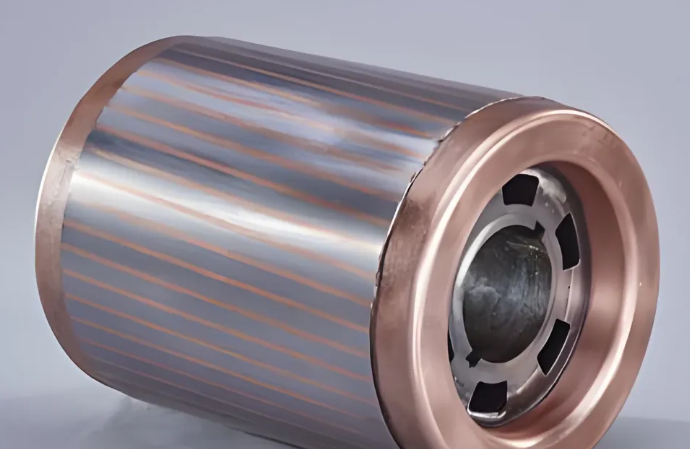
In terms of actual operating performance, both types of rotors have their advantages and disadvantages. Cast aluminum rotors have stable starting torque, low starting current, and low operating noise, making them suitable for most working conditions. However, they have weaker overload capacity and impact resistance, and experience greater losses, rapid temperature rise, and significant lifespan reduction under frequent start-stop operations and heavy loads. Copper rotors, on the other hand, have low operating losses, outstanding energy-saving effects, and stable temperature rise. They also have excellent overload capacity and impact resistance. Under conditions of high-frequency start-stop, variable frequency speed regulation, and long-term full-load operation, their operational stability far exceeds that of cast aluminum rotors, effectively reducing equipment energy consumption and minimizing downtime due to malfunctions.
From a motor selection perspective, practicality and advanced technology are the primary considerations, with cost-effectiveness often being a decisive factor. Cast aluminum rotors, with their high cost-effectiveness, are widely compatible with civilian fans, water pumps, general conveying equipment, and conventional machinery operating under light loads and continuous operation, making them the first choice for small and medium-sized general-purpose motors. Copper rotors, on the other hand, are primarily designed for heavy-duty, high-end industrial equipment, suitable for crushers, rolling mills, heavy-duty conveyors, variable frequency drives, high-frequency start-stop equipment, and industrial motors operating at full load continuously for 24 hours. They effectively reduce maintenance costs and improve equipment operating efficiency. In short: cast aluminum rotors are preferred for general operating conditions, while copper bar rotors are the preferred choice for demanding industrial conditions involving heavy loads, high frequencies, and long-term operation.
Post time: Aug-15-2026