Motor skewing is not a uniform standard option and a fixed pattern should not be blindly applied. The appropriate skewing or straight slotting scheme should be matched based on the number of motor poles, operating conditions, and type of supporting equipment. The principle of skewing is: the higher the number of poles, the greater the space for skewing optimization; the lower the number of poles, the more cautious should be in using large skewings; and for high-speed, low-pole motors, skewing should be weakened or even eliminated.
For multi-pole low-speed, high-torque motors with 8, 10, 12, or more poles, standard skewed slot design is preferred. This is especially important for permanent magnet motors and variable frequency motors, which often suffer from complex harmonics, low-speed torque pulsation, and electromagnetic noise. A well-designed skewed slot scheme can effectively counteract the harmful effects of power supply or magnetic field harmonics, such as protecting the permanent magnet rotor from harmonic eddy current damage and high-temperature demagnetization, and ensuring quiet and stable operation of motors powered by frequency converters. The significant effect of skewed slots in multi-pole low-speed motors has two implications: first, adjusting the skew amplitude has a significant impact on reducing noise and vibration; second, excessive skew can cause an excessively significant reduction in back EMF and output torque loss. Therefore, an optimal balance should be achieved between noise reduction, waveform stabilization, and dynamic performance.
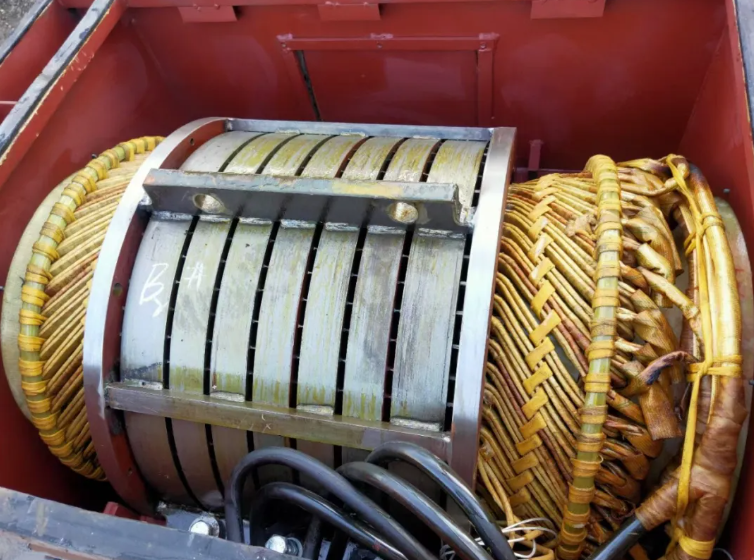
For 4-pole and 6-pole motors, selecting one stator or rotor tooth pitch with a standard skew slot is sufficient. As the most commonly used motor type in industry, common problems include no-load electromagnetic whistling, low-speed creeping, and torque fluctuation. Skew slots offer good performance without significantly sacrificing motor torque and operating efficiency.
For 2-pole high-speed motors with a large number of slots per pole and per phase, it is recommended to prioritize straight slot structures and avoid skewed slot designs as much as possible. Due to their inherently good magnetic field sinusoidal strength and low cogging torque, the optimization effect of skewed slots is negligible. Furthermore, under high-speed conditions, the axial magnetic field splitting effect caused by skewed slots significantly increases additional iron losses, reduces the motor’s effective output torque, and leads to decreased efficiency and increased temperature rise—the disadvantages outweigh the advantages. These types of motors do not need to rely on skewed slots to optimize performance; their electromagnetic performance can be improved through optimizing slot-pole matching, segmenting magnets, and optimizing core precision, making them more suitable for high-speed operation.
The number of slots on a fixed circumference is finite, which determines that the number of slots per pole and per phase cannot be too many. Moreover, the more poles there are, the fewer slots are allocated to each pole, resulting in a typical number of 2 to 5 slots per pole and per phase in multi-pole motors. According to the principle of making the air gap magnetic field as sinusoidal as possible, the more slots per pole and per phase of the motor, the better. Therefore, the magnetic field sinusoidality of a 2-pole motor is good, and the effect of skewed slots on improving the motor’s operating characteristics is not significant.
Post time: Aug-03-2026