In the IC416 forced air cooling system for variable frequency motors, the direction of rotation of the independent fan is not arbitrarily set; it directly determines the cooling airflow path. Incorrect rotation will cause cooling failure, and many field faults originate from reversed fan rotation. The core principle of fan rotation is to ensure that cooling air is blown in from the inlet of the rear fan shroud of the motor, passes through the internal air duct of the motor frame, flows through the stator core ventilation groove and the winding ends, and finally exits from the air outlets at the front of the motor or on both sides of the frame, forming a complete axial cooling airflow path.
Structurally, independent fans are typically installed at the non-drive end (rear end) of the motor. The rotating fan blades push air into the rear shroud cavity, through the ventilation holes on the back of the motor, and axially through the air gap between the stator and rotor, and the radial ventilation grooves of the stator. This carries away the heat generated by the windings and core, and the hot air is exhausted from the exhaust port at the front of the motor or the bottom of the frame. A simple way to determine the direction of rotation is to stand at the rear of the motor (fan side) and observe the fan. The direction of the fan blades should be such that air is drawn in towards the motor body, not drawn out. If the rotation is reversed, the fan will draw air outwards, preventing cool external air from entering the motor and thus preventing the heat from dissipating. Even if the fan is running at full speed, it will have almost no cooling effect.
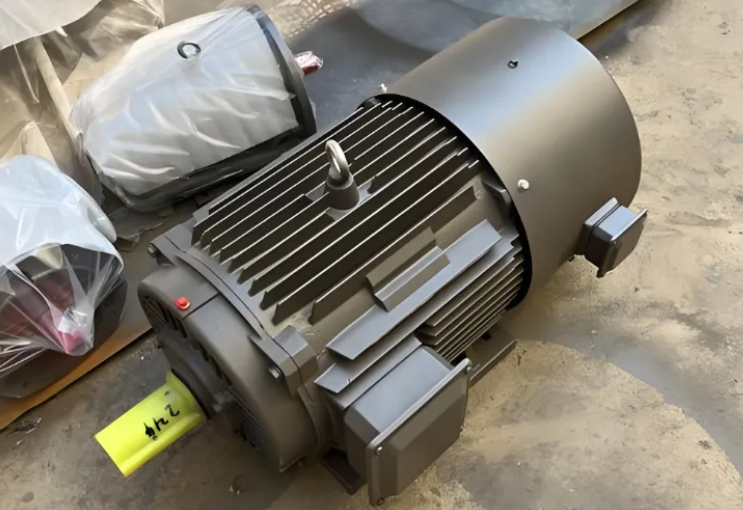
The direction of rotation of a fan must match the structure of its blades. Axial fan blades have a fixed curvature angle, and the blades can only generate effective air pressure in one direction. When rotating in the opposite direction, the air volume and air pressure will be significantly reduced, reaching only 30% or even less of the rated air volume, which cannot meet the heat dissipation requirements. It is not simply a matter of “airflow in both directions.” Centrifugal fans are even more sensitive to rotation direction. If the rotation is incorrect, the air pressure will drop sharply, and it will be completely unable to overcome the internal airflow resistance of the motor, resulting in false ventilation. For three-phase fans, changing the phase sequence of the wiring on-site can quickly adjust the rotation direction; for single-phase fans, it is necessary to check the internal wiring or reverse the installation direction of the blades.
In practical engineering, after installation, it’s not sufficient to judge whether the fan is running correctly; airflow verification is essential. During power-on testing, place pieces of paper or smoke at the motor’s outlet to confirm hot air is being expelled. Simultaneously, measure the motor’s no-load temperature rise to verify the cooling effect. Some models will have a rotating arrow marked on the fan cover; the arrow indicates the specified direction of the fan blades. Wiring must be consistent with this marking. It’s also important to distinguish between the motor’s main shaft rotation and the independent fan’s rotation: these are independent. The fan’s rotation is unaffected by the motor’s direction of rotation; regardless of whether the motor rotates forward or backward, the independent fan’s rotation remains constant, ensuring a consistent cooling airflow path.
The hidden dangers caused by incorrect rotation direction are highly deceptive. When the fan is rotating normally, inspectors may mistakenly believe the cooling system is functioning correctly. However, the motor continues to accumulate heat, causing the winding temperature to rise steadily. Prolonged operation will accelerate insulation aging, and in high-voltage motors, the sealant at the slot may even overflow due to heat, ultimately leading to overheating tripping and winding burnout. Therefore, after the installation, overhaul, or replacement of independent fans, the fan rotation direction and airflow direction must be checked as mandatory items to ensure the airflow path meets design specifications before putting the fan into operation under load.
Post time: Oct-19-2026