The most significant change in the motor industry in 2026 was that axial flux motors officially left the laboratory and entered the stage of mass production of tens of thousands of units. At the same time, high efficiency, high voltage, and intelligence constituted the main theme of technological iteration throughout the year, with multiple technical routes being promoted in parallel. Many solutions that were previously in the prototype and pre-research stage were successively put into mass production.
Axial flux is the most watched motor technology this year. China has built the world’s first production line for axial flux motors designed for mass production, with a planned annual capacity of 300,000 units. Orders are already booked until the first quarter of next year. Under the same power conditions, the size and weight of products from this technology are reduced by nearly half compared to traditional radial flux motors, with a maximum efficiency exceeding 97%, a speed of up to 18,000 rpm, and a power density that significantly exceeds long-term planning targets.
The key to performance improvement lies in the customized development of supporting magnetic materials. Specialized high-performance magnets control magnetic performance loss at 180 degrees Celsius to a low level, effectively alleviating the long-standing problem of high-temperature demagnetization that has hindered the widespread adoption of disc motors. Currently, this type of motor has expanded into multiple fields, covering new energy commercial vehicles, distributed drive systems for passenger vehicles, humanoid robot joints, low-altitude equipment, and various industrial equipment, achieving significant weight reduction in commercial vehicle scenarios such as heavy trucks.
In addition to this approach, the coreless axial flux scheme is also being developed. Relying on the advantage of eliminating core eddy current losses, it achieves higher energy conversion efficiency and forms a differentiated competitive approach.
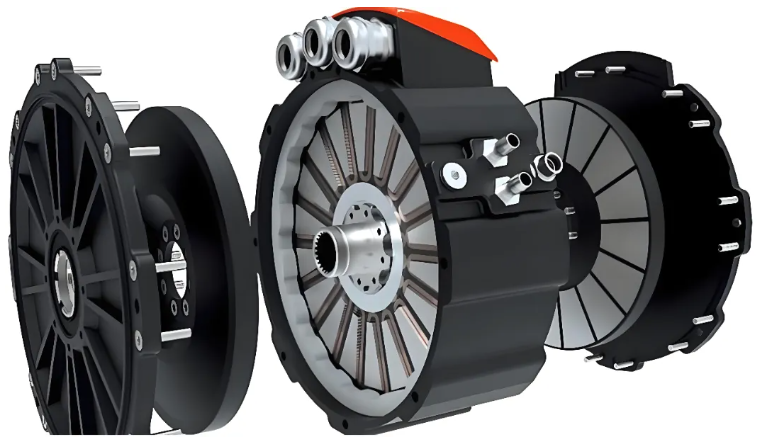
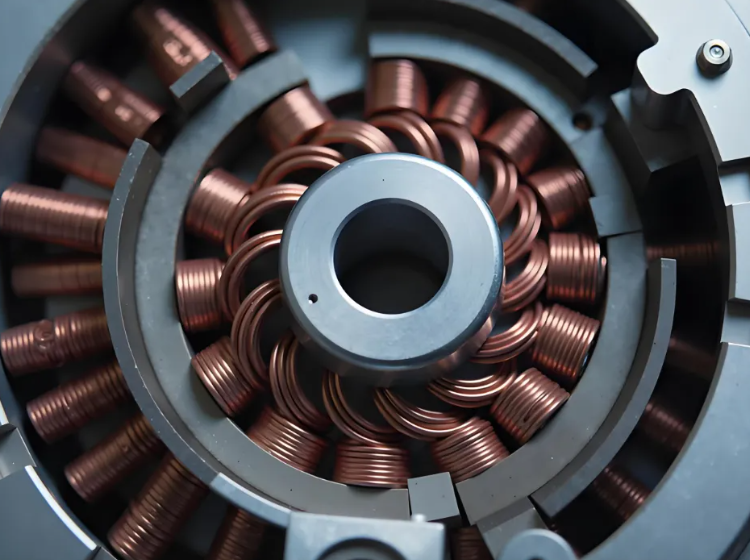
Addressing the high power density demands of automotive applications, a new continuous wave winding technology has successfully achieved industrialization and won an industry science and technology progress award. This solution utilizes a single conductor integral molding process, significantly reducing welding points, streamlining production steps, significantly improving slot fill factor, and controlling assembly precision within an extremely small tolerance range .
This electric drive system boasts impressive power density specifications for both its motor and controller, and has already achieved mass production of millions of units, gradually expanding from high-end models to mainstream passenger vehicle product lines. The main challenges in implementing the process lie in the continuous bending of long wires and the protection of thin insulation layers, requiring extensive debugging to ensure consistency across large batches of products.
Electric drive systems are migrating from traditional 800V platforms to kilovolt-level architectures, and the motor speed race has entered the 30,000 RPM mass production era. Multiple automakers have successively launched high-voltage, high-speed electric drive solutions: some mass-produced models achieve 30,000 RPM, paired with a kilovolt architecture and high-voltage silicon carbide devices; others feature high-speed motors, relying on high-strength silicon steel and a fully oil-cooled heat dissipation design, balancing high speed and high efficiency; and various platforms are continuously optimizing the temperature resistance and lifespan of silicon carbide modules, as well as overall lightweight design.
In terms of magnetic materials, grain boundary diffusion technology has become widespread, which can reduce the amount of heavy rare earth elements used while maintaining magnetic properties and anti-demagnetization capabilities. The development of electrically excited synchronous motors that are completely free of rare earth elements is accelerating, with priority currently being given to promoting vehicle installations in low-power auxiliary drive scenarios, while the main drive will still mainly use rare earth magnet solutions in the short term.
In winding manufacturing, multi-layer flat wire is becoming standard in high-end models, and short-end flat wire solutions are rapidly gaining popularity, further increasing slot fill factor. The carbon fiber rotor sheath for high-speed applications is also undergoing process upgrades, offering significant weight reduction and strength improvements compared to metal sheaths. In-line winding equipment is also under development to support the deployment of higher-speed models.
The expansion of the humanoid robot industry has driven a rapid increase in demand for frameless torque motors. The industry’s focus is no longer limited to single units, but has shifted to integrated joint modules. The technological goals are concentrated on improving torque density and suppressing torque pulsation, and axial flux has also become an important selection direction for joint motors .
The market structure is becoming increasingly segmented, with overseas brands dominating the ultra-high precision high-end market. Domestic manufacturers are focusing their efforts on closely aligning with OEMs, prioritizing mass production consistency and delivery capabilities. The remaining weaknesses in the supply chain are concentrated in high-precision encoders, specialized winding equipment, and potting equipment, which remain key areas for domestic production.
Motor maintenance is shifting from reactive repair after a failure to proactive predictive maintenance. By building digital twin models based on multi-dimensional sensor data such as temperature, vibration, current, and noise, early anomalies can be identified, enabling fault warnings and remaining lifespan estimations. Real-world application feedback indicates that this system improves fault identification accuracy and effectively reduces unplanned downtime.
Overall, this year’s motor innovation has moved beyond electromagnetic simulation and prototype verification. Materials, windings, magnets, and rotor processes have all matured collaboratively. High voltage, high speed, and new topologies are working in tandem, while downstream applications are rapidly expanding. Different approaches have their own suitable scenarios, and a single technology will not replace all solutions. Future competition will focus more on mass production consistency, cost control, and the maturity of the supporting supply chain.
Post time: Nov-11-2026